About the How Submarines Work
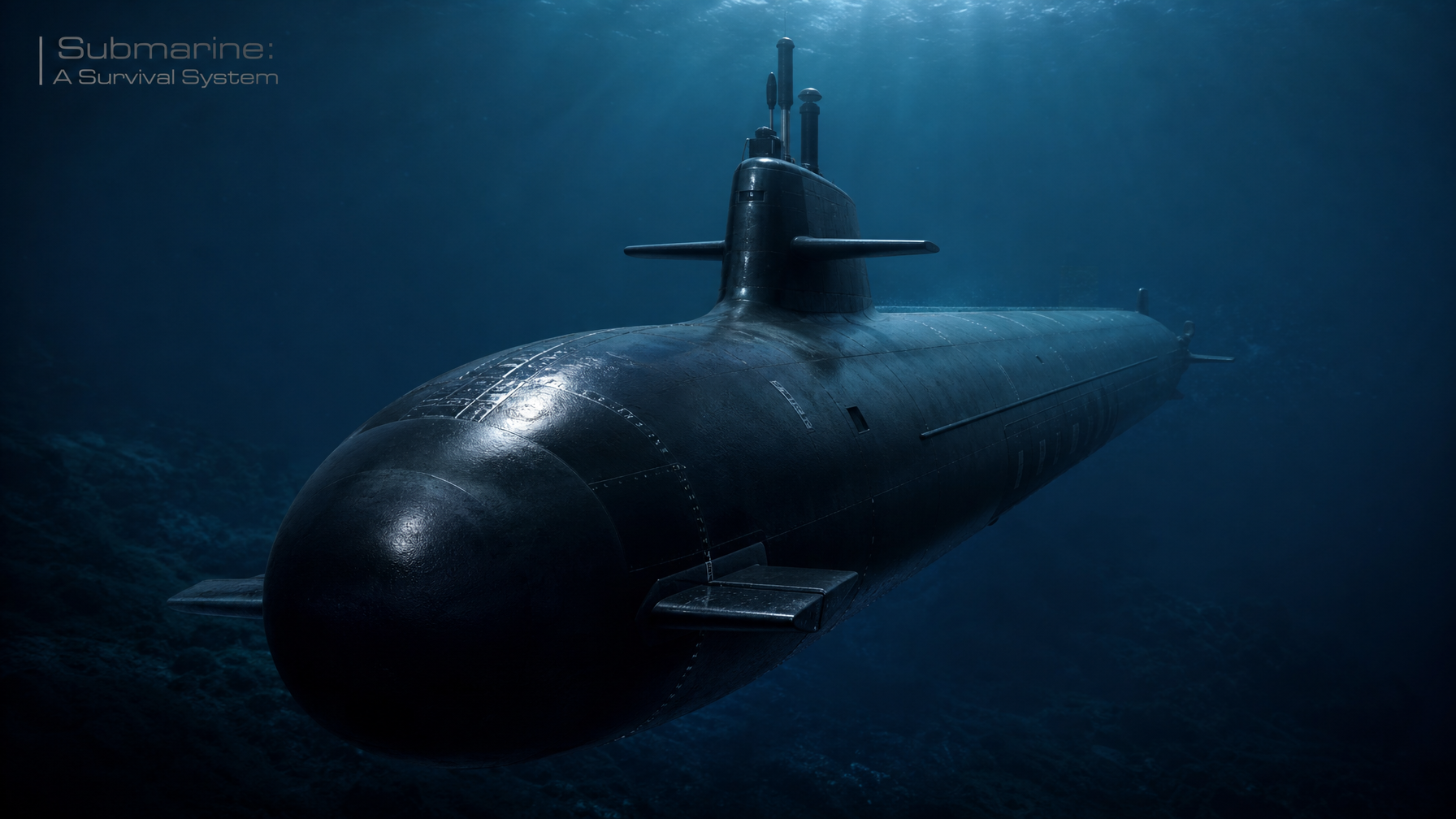
Ever wondered how submarines defy the ocean's crushing pressure and navigate its silent depths? Dive into the incredible engineering behind these underwater marvels, from buoyancy control and sonar to life support and stealth. Discover the ingenious systems that allow them to operate as self-contained survival machines. What's the most surprising submarine technology you've learned about?
Video script prompt
A submarine is not just a ship that can go underwater. It is a closed survival system that can control buoyancy, resist water pressure, move quietly, navigate in darkness, and detect the world through sound. The first key idea is buoyancy control. Any object in water experiences an upward force called buoyancy. A normal ship floats because it displaces enough water to support its weight. A submarine can float too, but it has one special advantage: it can change its weight. This is done with ballast tanks. When a submarine wants to dive, valves open and seawater enters the ballast tanks. The submarine becomes heavier, and it begins to sink. When it wants to surface, compressed air pushes the seawater out of the tanks. The submarine becomes lighter, and buoyancy lifts it back toward the surface. But a submarine does not simply sink or rise. It must control its depth smoothly. For this, it uses hydroplanes, which work a little like the control surfaces on an airplane. When the submarine moves forward, the hydroplanes adjust the flow of water and help the vessel rise, dive, or stay at a chosen depth. The submarine can also adjust its internal trim tanks to balance weight between the front and rear, keeping the hull level. The second key challenge is water pressure. The deeper a submarine goes, the greater the pressure becomes. Roughly every 10 meters of depth adds about one atmosphere of pressure. At great depth, seawater squeezes the submarine from every direction. The structure that protects the crew is called the pressure hull. This is the strong inner shell that holds air, people, and equipment. It is usually cylindrical or rounded because curved shapes distribute pressure more evenly. The outer shape of the submarine may look smooth and streamlined, but the pressure hull inside is the real protective shell. The third key technology is sonar. Light does not travel far underwater, and radar does not work well because electromagnetic waves weaken quickly in seawater. So submarines mainly use sound. There are two main types of sonar: active sonar and passive sonar. Active sonar sends out sound pulses and listens for echoes. It is useful for detecting objects, but it also reveals the submarine’s presence. Passive sonar is quieter. It does not send out sound. It only listens. It can detect propellers, engines, pumps, and other underwater noises. Modern submarines may use bow sonar, side sonar, and long towed sonar arrays to listen across large distances. This leads to one of the most important submarine abilities: silence. Underwater, sound can travel very far. A noisy submarine is easier to detect. That is why modern submarines are designed to reduce vibration and mechanical noise. Engines, pumps, pipes, and moving parts are isolated to prevent sound from spreading into the hull. The propeller or pump-jet is also carefully designed to reduce cavitation. Cavitation happens when fast-moving propeller blades create low-pressure areas in the water. Tiny bubbles form and then collapse, producing noise. For a submarine, cavitation can expose its location, so quiet propulsion is extremely important. Submarines also need a reliable power system. Conventional submarines often use diesel engines and batteries. The diesel engine charges the batteries near the surface, and underwater the submarine runs on electric power. Electric operation can be quiet, but battery endurance is limited. Nuclear submarines use a nuclear reactor to produce heat. That heat creates steam, which drives turbines and generates power. A nuclear submarine does not need to surface frequently for air or battery charging, so it can remain underwater for a very long time. Its limits are more often food supply, maintenance, and crew endurance. Another major challenge is life support. A submarine is a sealed environment. The crew needs oxygen, but they also produce carbon dioxide. The submarine must supply oxygen, remove carbon dioxide, filter the air, control humidity, manage temperature, and provide fresh water. Some submarines can produce oxygen from seawater through electrolysis. Carbon dioxide can be removed with chemical scrubbers. Fresh water can be made by desalination systems. Communication underwater is also difficult. Normal radio signals do not travel well through seawater. To receive detailed messages, a submarine may need to rise closer to the surface and use an antenna or floating communication device. Very low frequency signals can reach deeper underwater, but they carry only small amounts of information. Navigation is another problem. GPS signals cannot penetrate deep water. Submarines mainly use inertial navigation systems, which track position using gyroscopes and accelerometers. Over time, small errors can build up, so submarines may occasionally need other methods to correct their position. Modern submarines may also use an optronic mast instead of a traditional periscope. A traditional periscope uses optical tubes to let the crew see above the surface. An optronic mast uses cameras, infrared sensors, and digital displays. This allows the submarine to observe the surface while exposing less equipment above the water. In an emergency, a submarine can perform an emergency blow. Compressed air is released into the ballast tanks very quickly, forcing water out and increasing buoyancy. The submarine rises rapidly toward the surface. This maneuver is risky and is usually reserved for serious emergencies.
How to use this Explainer video template
Template Name: How Submarines Work
Step 1
Click the "Use Template" button to load the "How Submarines Work" preset.
Step 2
Review the default settings. This template is pre-configured with the Hailuo 02 model and Cine Science style. Click "Run Script" to generate your initial draft.
Step 3
Enter your scene description in the text box. The One-Click engine is powered by Hailuo 02 to interpret complex prompts instantly. Toggle the Directing Modes if you need specific camera movements.
Step 4
Browse the Video Style carousel to pick a look. Ensure your Aspect Ratio is set correctly (16:9) for your target platform.
Step 5
Hit the "Create Video" button. The AI will process your script and style simultaneously to deliver a finished video.
How Submarines Work Video Template
Start to use this template
Template Specifications
Frequently Asked Questions
What is an explainer video template?
Explainer templates are pre-designed videos that help you explain ideas, products, or services clearly and visually.
Do I need design skills to use these templates?
No. Magiclight templates come ready-to-use; you only need to add your text, images, or voiceovers.
Can I customize the text and visuals in explainer videos?
Yes. Magiclight lets you edit text, replace images, and adjust visual elements to clearly present your ideas or products.
Are explainer templates suitable for business presentations?
Absolutely. They are perfect for marketing, training, product demos, or investor pitches.
What can I use explainer templates for?
Magiclight's explainer templates are perfect for product demos, service introductions, training videos, or sharing ideas in a clear and engaging way.
You might also like
these trending designs