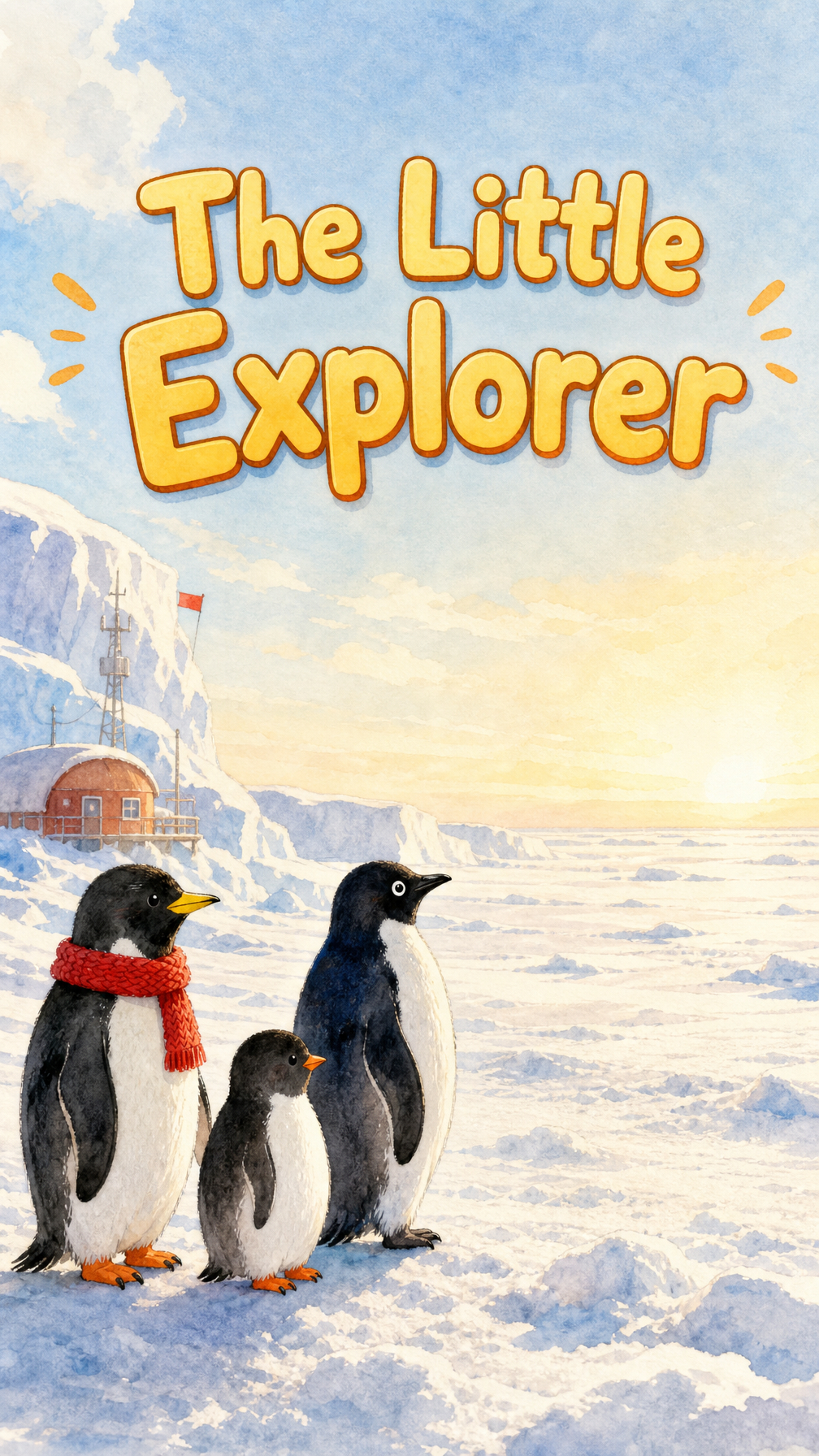
About the The Little Explorer
Watch as a tiny penguin chick takes its first brave steps alone across the vast, icy Antarctic landscape. This heartwarming journey of discovery tests its courage against the elements, but will it find its way back home? Follow along as this little explorer learns what it truly means to be brave.
Video script prompt
可以,我按之前的《小企鹅第一次离开家》来,给你做成**5000字以内、可直接用于生成视频的完整英文提示词**。故事保持“小企鹅第一次离开家”的核心,不改成别的剧情,同时加入你之前要求的**角色一致、正常速度、无特殊效果、无慢动作**。 Create a heartwarming cinematic children’s animal adventure video based on the story “Little Penguin’s First Journey.” The story follows one young penguin experiencing its first adventure away from home, discovering the wider Antarctic world, facing a small challenge, learning courage and independence, and eventually returning home safely. Keep the storytelling simple, emotional, visually clear, and suitable for children. [GLOBAL CHARACTER CONSISTENCY] The main character is always the SAME little penguin throughout the entire video: a young emperor penguin chick with soft fluffy dark-gray feathers covering the head, back, and wings, a soft pale-gray to white belly, a small rounded body, short dark-gray flippers, tiny dark feet, a short dark beak, large expressive dark eyes, and a cute childlike appearance. Keep exactly the same face, eye shape, beak, feather colors, body proportions, height, size, and overall character design in every shot. Never redesign, replace, morph, age, recolor, enlarge, shrink, or transform the penguin. The mother penguin is always the SAME adult emperor penguin with a black head and back, white belly, dark beak, natural adult proportions, and recognizable facial markings. Keep her appearance identical whenever she appears. The father penguin, if shown, is always the SAME adult emperor penguin with identical fixed appearance throughout the story. Do not introduce unnecessary human characters. The story should focus entirely on penguins and the natural Antarctic environment. [MOTION AND VISUAL RULES] All actions happen at natural real-time speed. No slow motion, no time stretching, no speed ramps, no frozen poses, no artificially delayed reactions, and no unnaturally slow walking or movement. Penguin waddling, sliding, swimming, climbing, falling, turning, and reacting should feel natural and physically believable. No magical effects, glowing particles, fantasy energy, sparkles, aura, artificial beams, explosions, smoke effects, or supernatural transformations. Natural sunlight, snow, ice reflections, wind, snow movement, and water splashes are allowed. Keep the visual style cinematic, polished, emotional, and believable, with realistic Antarctic lighting, natural snow textures, detailed ice, soft atmospheric depth, and expressive animal animation. [SCENE 1 — HOME] Open on a vast Antarctic landscape covered in snow and ice. A small penguin family stands together near their familiar snowy home. The little penguin stays close to its mother and father, watching the distant landscape with curiosity. The little penguin looks toward the wide open Antarctic horizon as if wondering what lies beyond its home. [SCENE 2 — CURIOSITY] The little penguin walks around the family’s familiar area, exploring small patches of snow and ice. It looks at distant ice formations, footprints, and the open ocean. The mother watches the little penguin carefully. The little penguin is clearly curious and eager to explore but still inexperienced. [SCENE 3 — FIRST STEP AWAY] The little penguin notices something interesting in the distance and takes a few steps away from its parents. It looks back toward them. The mother remains nearby and watches calmly. The little penguin takes another few steps forward, gaining confidence. [SCENE 4 — LEAVING HOME] The little penguin begins walking farther from its family for the first time. It waddles across the snow while repeatedly looking back. The familiar home gradually becomes farther behind. The penguin is excited but slightly nervous. Keep the emotion subtle and believable. [SCENE 5 — THE OPEN ANTARCTIC WORLD] The little penguin reaches a wider snowy area and sees a huge frozen landscape for the first time. Tall ice formations, distant glaciers, snow-covered ground, and the ocean stretch across the horizon. The little penguin stops briefly and looks around in amazement before continuing forward. [SCENE 6 — PLAYING IN THE SNOW] The little penguin discovers a gentle snowy slope. It walks up the slope, loses its balance naturally, and slides down on its belly. It quickly gets back up and looks excited. It tries again, becoming more confident. The movement should be playful and natural, not exaggerated. [SCENE 7 — THE FROZEN SHORE] The little penguin reaches the edge of a frozen shoreline. It sees the ocean below the ice. Small waves move naturally beneath and around the ice. The penguin carefully approaches the water and looks down with curiosity. [SCENE 8 — FIRST SWIM] The little penguin cautiously enters the shallow water. It initially moves awkwardly, then begins paddling with its flippers and feet. Soon it discovers that swimming comes naturally. It swims through clear cold water near floating pieces of sea ice, looking excited and confident. [SCENE 9 — TOO FAR] The little penguin becomes distracted while exploring the water and gradually moves farther from the familiar shore. It eventually looks back and realizes that the shore is farther away than expected. Its expression changes from excitement to uncertainty. [SCENE 10 — A SMALL CHALLENGE] The weather becomes slightly rougher. Wind moves across the snowy surface and small pieces of snow blow naturally through the air. The little penguin carefully makes its way back toward the ice. It struggles briefly against the wind but continues moving forward. [SCENE 11 — SLIPPERY ICE] The little penguin climbs onto a large piece of sea ice. Its feet slip naturally on the smooth surface and it falls onto its belly. It pauses for a moment, then pushes itself back up using its flippers. The penguin looks determined rather than frightened. [SCENE 12 — FINDING THE WAY] The little penguin looks across the ice and recognizes a distant landscape that seems familiar. It begins following a trail of penguin footprints across the snow. The footprints lead toward the direction of home. The penguin walks with renewed confidence. [SCENE 13 — DISTANT CALL] The little penguin stops and hears a familiar penguin call in the distance. It turns its head toward the sound. The sound comes from far away. The little penguin immediately recognizes the voice of its family and starts moving toward it. [SCENE 14 — RUNNING HOME] The little penguin waddles and runs across the snow as quickly as its small body naturally allows. It crosses the snowy landscape, moving toward its family. The camera follows from behind and from the side, showing the long journey it has made. [SCENE 15 — FAMILY REUNION] The mother penguin appears in the distance, searching for the little penguin. The little penguin sees her and immediately moves toward her. The mother approaches as well. They meet and gently touch their beaks and bodies in a warm reunion. The father penguin may stand nearby, visibly relieved. [SCENE 16 — HOME AGAIN] The little penguin returns to the family’s familiar home. It looks around at the snow, ice, and surrounding landscape with a new sense of confidence. The place looks the same, but the little penguin has changed emotionally because of the experience. [SCENE 17 — SHARING THE ADVENTURE] The little penguin stays beside its mother and looks toward the distant landscape. The mother looks at the little penguin affectionately. The little penguin appears proud and happy, as if silently sharing everything it experienced during its first journey. [SCENE 18 — THE NEXT ADVENTURE] End with the little penguin standing beside its parents while looking toward the vast Antarctic horizon. The three penguins remain together against the beautiful snowy landscape. The little penguin is no longer afraid of the world beyond home. It has learned that being brave does not mean never being afraid—it means exploring, facing difficulties, and knowing where home is. [FINAL SHOT] A wide cinematic shot shows the little penguin standing between its parents on the snow-covered Antarctic landscape. The family remains together while the little penguin looks toward the distant ocean and mountains. Natural daylight, gentle wind, realistic snow movement, peaceful atmosphere, warm emotional ending. [STRICT CONTINUITY] The little penguin must remain the exact same character in every scene. Keep identical feathers, colors, eyes, beak, body proportions, size, and facial design. The mother and father must also remain visually consistent. The story progression must remain: penguin family at home → little penguin becomes curious → first steps away → leaves home → discovers the Antarctic → plays in snow → reaches frozen shore → enters water → swims farther than expected → realizes it is far from home → faces wind and slippery ice → finds penguin footprints → hears family → travels home → reunites with family → returns home → shares the experience → looks toward the future. Do not change the story into a dangerous survival story. The challenge should remain gentle and child-friendly. Do not kill, injure, or threaten the penguins. Natural real-time movement only. No slow motion, no time stretching, no speed ramps, no frozen poses. No magical effects, no glowing objects, no fantasy particles, no artificial energy, no supernatural transformations. No humans, no random animals, no character redesigns, no unexplained size changes, no random costumes or accessories. Maintain a cinematic children’s animated-film quality with believable animal movement, expressive faces, detailed snow and ice, natural Antarctic lighting, realistic environmental physics, clear visual storytelling, and a warm emotional tone.
How to use this Cartoon video template
Template Name: The Little Explorer
Step 1
Click the "Use Template" button to load the "The Little Explorer" preset.
Step 2
Review the default settings. This template is pre-configured with the magiclight_3_lite model and Picture book style. Click "Run Script" to generate your initial draft.
Step 3
Enter your scene description in the text box. The One-Click engine is powered by magiclight_3_lite to interpret complex prompts instantly. Toggle the Directing Modes if you need specific camera movements.
Step 4
Browse the Video Style carousel to pick a look. Ensure your Aspect Ratio is set correctly (9:16) for your target platform.
Step 5
Hit the "Create Video" button. The AI will process your script and style simultaneously to deliver a finished video.
The Little Explorer Video Template
Start to use this template
Template Specifications
Frequently Asked Questions
What kind of cartoons can I create with Magiclight?
You can create short animated stories, funny clips, and character-driven scenes using Magiclight's cartoon templates. Styles range from classic 2D animation to stylized digital cartoons.
Do I need animation experience to use these templates?
No experience is needed. Magiclight's cartoon templates are pre-built with animations, characters, and backgrounds, so you can create videos in minutes.
Can I customize characters and scenes in cartoon templates?
Yes! You can edit characters, change colors, add props, and adjust backgrounds to fit your story.
Are cartoon templates suitable for social media posts?
Absolutely. They are optimized for TikTok, Instagram Reels, YouTube Shorts, and more.
Can I add my own voiceovers to cartoon videos?
Yes. Magiclight allows you to add voiceovers, music, or sound effects to bring your cartoon to life.
You might also like
these trending designs