Scenes are the basic units of every film, since each one moves the story forward in a single place and time. The answer to “how many scenes in a movie” depends on runtime, genre, and how you count. For a typical 2-hour feature, the figure usually sits between 40 and 60.
Scene count also shapes production, because every new location adds setup time, cast scheduling, and editing work. MagicLight AI helps creators turn long, multi-scene scripts into one animated video with a steady cast.
Part 1. How Many Scenes Are in a Movie?
Screenwriting manuals usually answer “how many scenes in a film” with a simple formula. Since scenes span 2 or 3 pages, a 120-page screenplay may contain about 40 to 60 scenes. David Bordwell found 1930–1960 Hollywood scenes averaged roughly 2 to 4 minutes. After 1961, scenes commonly became shorter, often running 1.5 to 3 minutes.
Some later films move faster, with Cameron Crowe’s Singles averaging only 66 seconds per scene. Stephen Follows analyzed 12,309 feature screenplays and found a much higher average of 110 scenes. New headings for location changes can split one chase across several separate scenes. The final total depends on what counts as a scene, and three filmmaking terms often get confused:
- Scene: Continuous action in one location and time forms a scene, and a script marks each one with a heading starting INT. or EXT.
- Shot: One uninterrupted camera takes a shot, so Victoria (2015) counts as a single 138-minute shot despite its many scenes.
- Sequence: Several scenes tied to one goal, such as a chase, form a sequence that works like a book chapter.
Part 2. How Many Scenes Are in a Movie by Genre and Story Type?
There is no fixed scene count for every movie, since genre and story structure can change the number considerably. Some films rely on longer conversations, while others move quickly between locations, characters, and events. The table below compares typical scene counts by genre, helping answer how many scenes are in a movie across different types of stories:
| Genre | Typical Scene Pattern | Benchmark |
| Action | Many short scenes that change location often | Scripts average 131.2 scenes, the most of any genre |
| Comedy | Fewer, longer scenes that give jokes room to build | Scripts average 98.5 scenes, the fewest of any genre |
| Drama | Long, dialogue-heavy scenes built on performance | There Will Be Blood opens with an unusually long visual sequence, with roughly its first 7 script pages containing no dialogue. |
| Horror | Shorter scenes that keep the tension rising | The Babadook fits 56 scenes into 100 pages |
The genre averages come from Stephen Follows’ study, while individual film figures draw on breakdowns from StudioBinder and ScriptShadow. However, how many scenes in a movie also depends on the way its story unfolds. Location changes, multiple storylines, and shifts in time can all affect the final count, as these common story structures show:
- One-Location Stories: Films set mainly in one place can use fewer, longer scenes. 12 Angry Men spends nearly all its 96 minutes in 1 jury room, allowing extended debates instead of frequent location changes.
- Multiple-Character Stories: Stories following several main characters often require more scenes. Each storyline needs its own space, with the film regularly cutting between characters and events.
- Travel and Adventure Stories: Road movies, war films, and fantasy quests regularly introduce new settings. Moving between locations naturally creates more scene changes throughout the screenplay.
- Stories Across Different Timelines: Flashbacks, flash-forwards, and other timeline shifts can increase scene totals. Each change in time or setting generally requires a separate scene heading.
Part 3. How to Plan the Number of Scenes in a Movie
Once the story takes shape, how many scenes in a movie becomes a practical planning decision. Start with the target runtime, then divide the story into moments that move the plot forward. This approach keeps the script, shooting schedule, and budget manageable. The steps below show how to estimate and organize your scene count from the first outline:
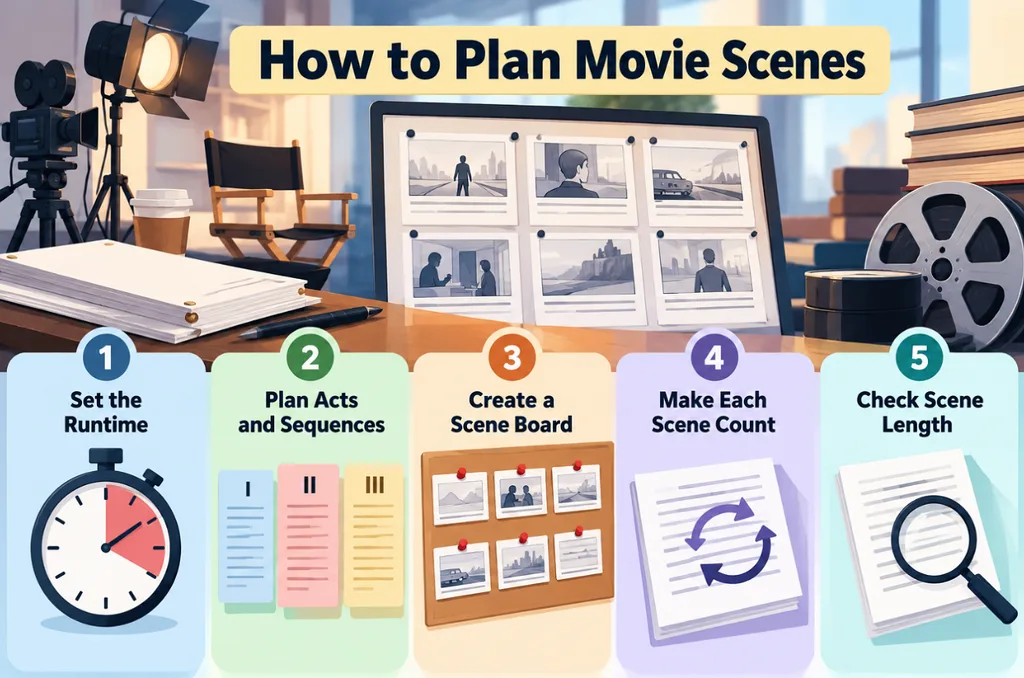
Step 1. Set the Runtime First
Choose the target length before outlining, because it fixes the page budget. A standard 90- to 110-page screenplay produces a film of about 90 minutes to two hours.
Step 2. Divide the Story Into Acts and Sequences
Split the pages into three acts, with the middle act taking around half of the runtime. SoCreate describes typical sequences of 10 to 15 pages, each holding three to seven scenes.
Step 3. Generate a Scene Card Board
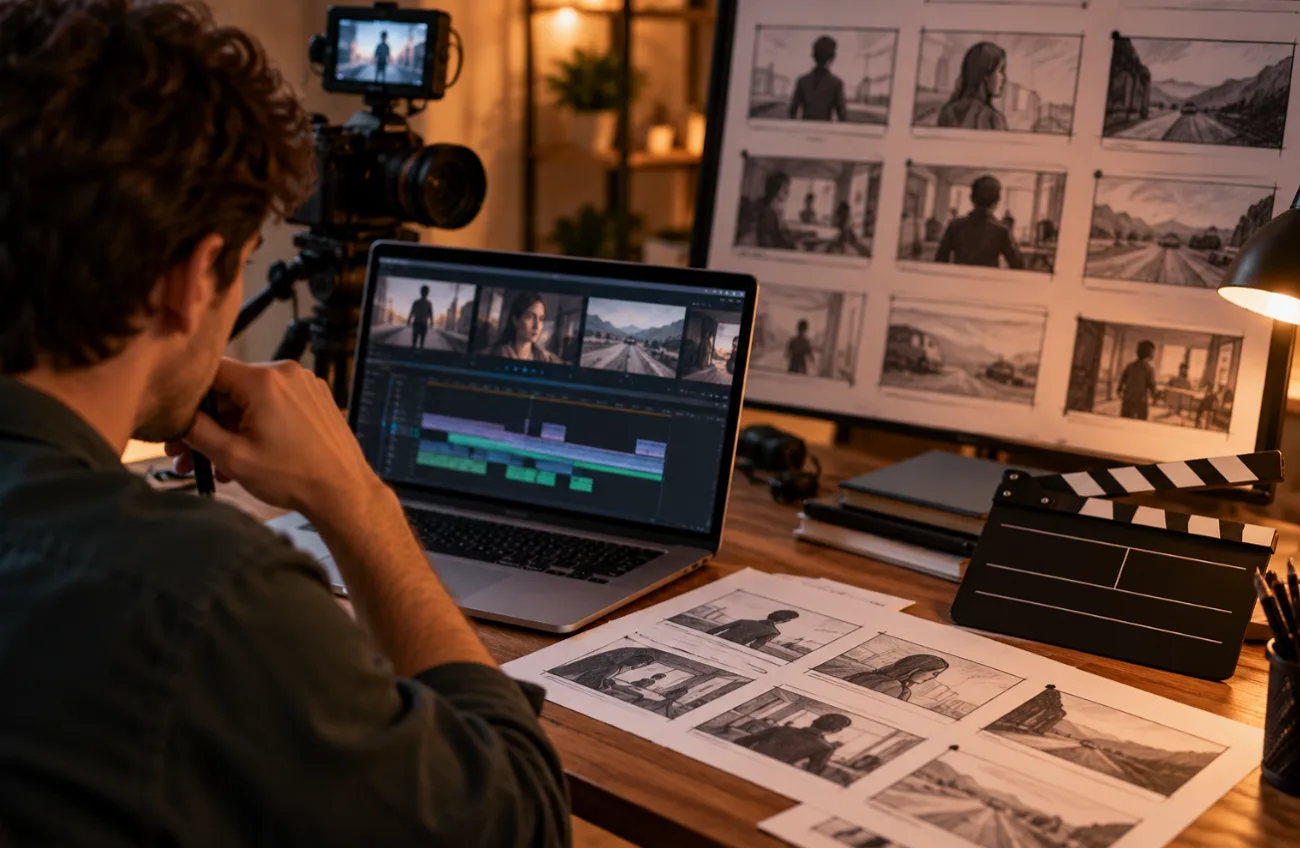
Write each planned scene on an index card and pin the cards in act order. Blake Snyder’s Save the Cat method builds its board from 40 scene cards, a manageable number to shuffle and test.
Step 4. Give Every Scene a Turn
Robert McKee defines a scene by change, so each one should turn a value in a character’s life, such as trust into doubt. Cut or merge any card where nothing changes, since static scenes slow the pace.
Step 5. Check the Average Scene Length
Divide the page count by the number of scenes to find the average length. ScriptShadow suggests keeping that average between 1.5 and 2.5 pages, saving longer scenes for the climax and major confrontations. A 100-page script with 40 scenes averages 2.5 pages, right at the upper edge.
Part 4. Why More Scenes Can Require Longer Video Production
The answer to how many also affects the time needed to shoot and finish it. Each new scene may require different lighting, camera positions, locations, and continuity details. Since the Follows study found an average location appears in only 1.5 scenes, higher scene counts can create extra work across these production stages:
- Moving Between Locations: Transporting cast, crew, and equipment can take hours, especially when several locations appear in one shooting day.
- Time Needed for Each Scene: Indie productions often cover three to five dialogue pages daily, while a short stunt scene can take much longer.
- Keeping Details Consistent: Costumes, props, lighting, and character positions must match when scenes are filmed across different takes and days.
- More Work After Filming: Extra scenes bring more footage, cuts, sound adjustments, transitions, and color matching during post-production.
AI video production faces the same multiplication problem, only at the level of clips. Many models generate one shot at a time, and Veo 3.1 tops out at 8 seconds per generation. At that length, a 2-minute scene needs about 15 generations. A 50-scene film turns that into 100 clips, and faces or costumes can drift between them.
MagicLight AI sidesteps that clip-by-clip grind, since it builds an entire multi-scene story inside a single project. Saved characters keep the same face and outfit through every scene, and backgrounds hold a steady style. Depending on the plan, the Long Video Generator offers 30- and 50-minute options, room enough for dozens of scenes.
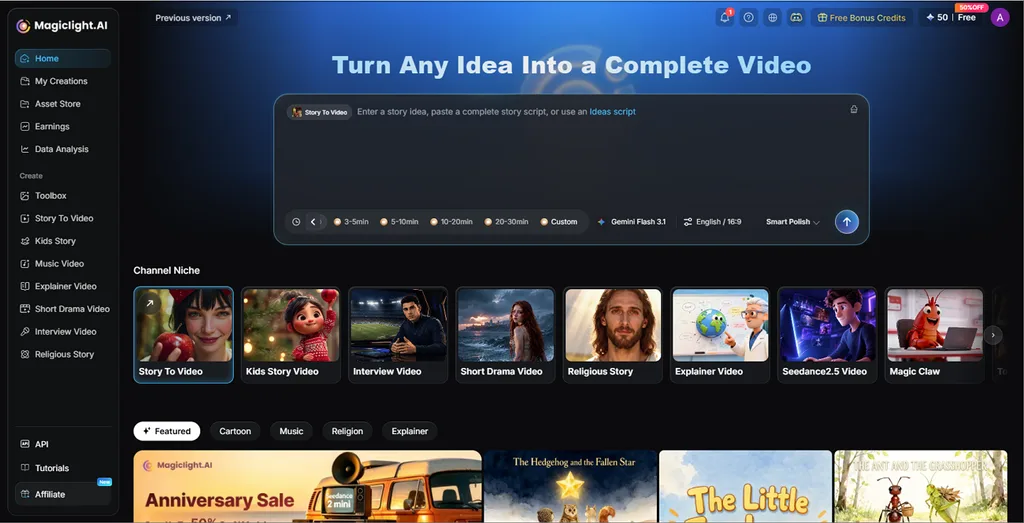
Projects start with MagicLight Agent, which turns a short idea into a scene-by-scene script and picks the niche without prompting. Story to Video then lays the scenes out in order, with poses, expressions, and clothes adjustable shot by shot. Any shot that looks off can be regenerated, and paid plans drop the watermark from 1080p downloads.
Conclusion
Most 2-hour features land between 40 and 60 dramatic scenes, although one large script study averaged 110. Genre, structure, and runtime all change the answer to “how many scenes in a movie,” so planning should start from the target length. Among AI scene generators, MagicLight AI keeps one cast consistent across a single long animated video.
FAQs on How Many Scenes Are in a Movie
1. How many scenes are usually in a movie?
The usual reply to “how many scenes in movie” questions is 40 to 60 dramatic scenes for a two-hour feature. Script databases show higher totals, with one study of 12,309 screenplays averaging 110. Action scripts run above that average, while comedies fall under it.
2. How many scenes are in a 2-hour movie?
A 2-hour film usually starts from a script of around 120 pages. Scenes of two to three pages put the total near 40 to 60. Deadpool fits 44 scenes into 113 pages, while action scripts in one large study averaged 131.
3. How many scenes are in a short film?
Short films follow the same one-page-per-minute rule, so their scene counts shrink along with the runtime. The Film Fund notes that a 15-minute short may contain only about 15 scenes in total. Plenty of shorts unfold entirely in a single room.
4. Does a longer movie need more scenes?
Longer films usually add subplots and locations, which raises the scene count. A runtime can also grow through longer, slower scenes. My Dinner with Andre fills most of its 110 minutes with one dinner conversation, proving that few scenes can carry a long film.
5. Can AI help create a movie with many scenes?
AI tools can outline scenes, draft dialogue, and generate visuals for each part of a story. Keeping characters consistent across dozens of scenes is the hard part. MagicLight AI addresses that with saved characters and single projects reaching 50 minutes on paid plans.