Pricing remains one of the least settled and clearly explained parts of the Seedance 2.5 model. Early information suggested clearer rates would arrive around release, but pricing details remain difficult to compare. Seedance 2.5 pricing and credits now involve token rates, platform credits, and different calculation methods.
These overlapping systems make estimating the true cost of a finished video unnecessarily confusing for users. This guide separates each pricing method and calculates the estimated cost of generating a 30-second video.
Part 1. How Seedance 2.5 Pricing Works
Understanding Seedance 2.5 pricing and credits begins with knowing how its billing system works. Different platforms use this billing system differently, which can make final costs harder to compare.
Token-Based Billing and Per-Second Estimates Explained
Billing measures computing work used by each generation instead of charging fixed video prices. Billable tokens are divided by one million, then multiplied by the applicable token rate. Per-second figures are derived because ByteDance provides worked examples using fixed generation settings instead.
Industry estimates convert these examples into per-second rates, making video budgeting easier. Identical requests may cost differently because frame rate, dimensions, and returned tokens can vary.
What Drives Cost Up or Down
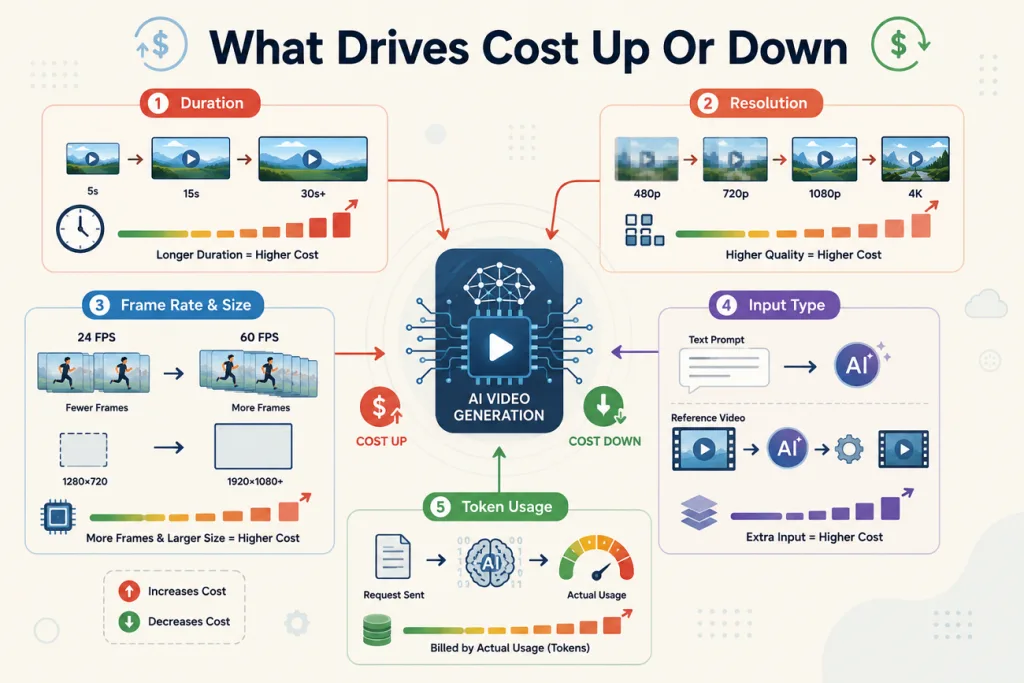
Now, let's examine 5 important factors that can increase or decrease generation costs:
- Duration: Cost scales with output length, which makes the thirty-second ceiling the new billable unit.
- Resolution: Moving from 480p to 720p roughly doubles the rate, and 4K climbs further still.
- Frame Rate and Dimensions: Both feed into the token count before any content is considered.
- Input Type: Requests carrying a reference video bill on a different structure entirely.
- Returned Token Usage: The final figure reflects actual consumption rather than an estimate made in advance.
Official API Rates vs. Consumer Platform Credits
The table below explains how official API rates and consumer platform credits differ:
| Figure Type | Where It Comes From | What It Leaves Out |
| Official API Rate | ByteDance or official API provider | Any platform margin |
| Official Example | An official sample at one fixed setting | Other resolutions and durations |
| Calculated Estimate | A projection built from published pricing | Variation in actual token usage |
| Consumer Credit Price | Credits charged inside Dreamina or Jimeng | The underlying API cost |
| Third-Party Price | A reseller or aggregator's own rate | Platform-specific fees or pricing differences |
Part 2. Seedance 2.5 Cost by Resolution and Duration
Seedance 2.5 pricing and credits vary by resolution, duration, and actual token usage during generation. To compare estimated costs across different resolution tiers and video lengths, look at the table below:
| Resolution | Reported Cost/Second | Estimated 30-Second Clip |
| 480p | About $0.10 | Around $3.10 |
| 720p | About $0.23 | Around $6.95 |
| 1080p | No separate rate published | Estimated between 720p and 4K costs |
| Native 4K | No Seedance 2.5 rate published | About $10.60 using Seedance 2.0 pricing |
| Any Tier With Video Reference | Up to $0.89 | Approximately $26.70 |
The final row matters because adding a reference video uses different billing and can significantly increase generation costs.
Part 3. Seedance 2.5 Credits on Dreamina and Jimeng
Dreamina and Jimeng use platform credits instead of showing users direct token-based generation costs. Their credit systems make budgeting easier but comparing them with API pricing becomes harder. Look at the table below to compare how both platforms charge for Seedance generations:
| Aspect | Dreamina | Jimeng |
| Free Allowance | Free daily/trial credits; amount varies | Limited free/login credits may be available |
| Seedance 2.0, 5-Second Clip | Credit cost varies by settings and region | Credit cost varies by settings |
| Seedance 2.5, 30-Second 720p Clip | Around 660 credits reported | Around 660 credits reported, unconfirmed |
| Access Requirement | Availability varies by account and region | Chinese account access may be required |
| Renewal Pricing | Depends on current subscription plan | Depends on current membership plan |
| Developer API | Consumer creator interface | Consumer creator interface |
Dreamina can offer better promotional pricing, while Jimeng may become cheaper after those offers expire.
Part 4. Seedance 2.5 API Pricing for Developers
Seedance 2.5 pricing and credits use billable tokens for developer access through official platforms. The table below compares key API rates and costs developers should consider:
| Request Type | Published Token Rate | Applies To |
| Without Video Input | About $10.70/million tokens | 480p and 720p output |
| With Video Input | About $6.40/million tokens | Reference-conditioned requests |
Video-conditioned requests may show lower token rates, which can initially appear more affordable. However, they consume significantly more tokens, causing overall generation costs to increase considerably.
Key API Details for Developers
- Asynchronous Generation: Production systems require task IDs, polling, callbacks, and clear retry rules for requests.
- Model Identifier: BytePlus uses dreamina-seedance-2-5-260628, which differs from model names used by third-party aggregators.
- No Consumer Bridge: Dreamina provides no API connecting consumer credits directly with developer billing accounts.
Part 5. Best Way to Use Seedance 2.5 in MagicLight AI
Per-second billing has one structural weakness that rarely gets clearly mentioned when discussing generation costs. Simple scenes and visually dense scenes cost exactly the same at any selected resolution level. Therefore, this pricing approach offers no reward for keeping individual video shots more economically.
MagicLight AI includes Seedance 2.5 Pro among its selectable engines but uses different billing methods. This difference changes the arithmetic for users producing longer content instead of individual video clips.
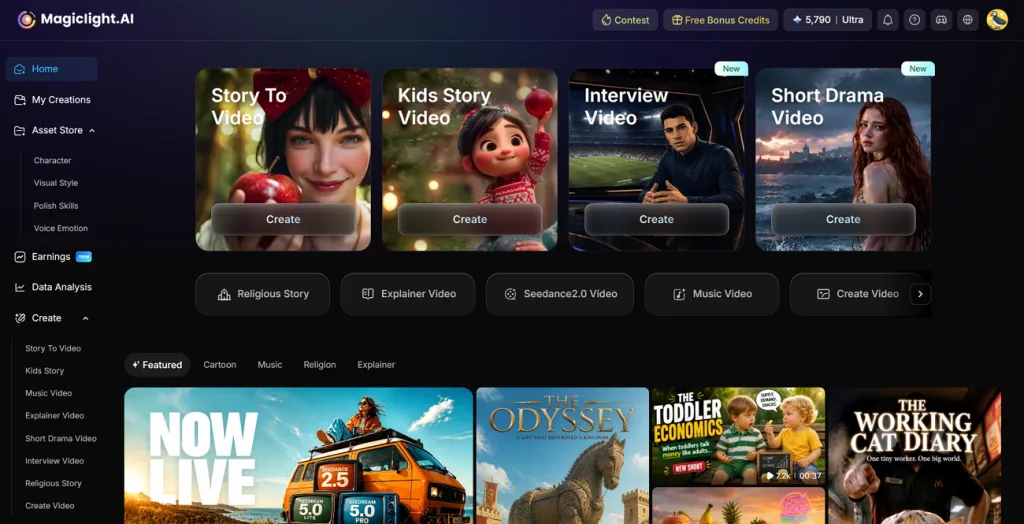
How MagicLight AI's Credit System Works
Now, let's examine 3 key factors that determine how MagicLight AI credits are consumed:
- Video Length: Users can create long videos up to 50 minutes, with longer projects consuming more credits.
- Style Complexity: Simple 2D scenes use fewer credits than photorealistic sequences of the same length.
- Resolution: Videos support output up to 1080p, with higher resolutions consuming more available credits.
To understand how these factors affect credit usage in practice, look at the table below:
| Project | Approximate Credit Cost |
| 2 Minutes, Basic Style, 720p | 500–1,000 credits |
| 5 Minutes, 3D Cartoon, 720p | 800–1,200 credits |
| 10 Minutes, Photorealistic, 1080p | 5,000+ credits |
The platform displays a cost estimate before processing begins, which token billing cannot do because consumption is only known afterward. Credits are non-refundable once spent, so checking that estimate matters.
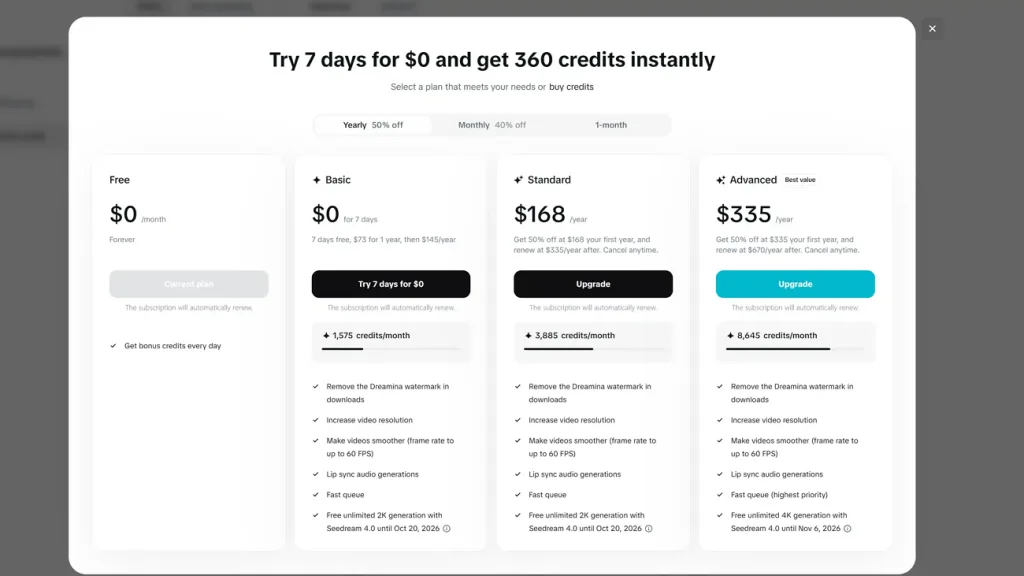
A free plan offers limited credits without requiring a card, while paid plans include commercial rights. Paid plans also provide access to the complete style library for creating different types of videos. Plan prices have changed several times, so always check current pricing directly before completing checkout.
Conclusion
To summarize, Seedance 2.5 pricing and credits vary based on resolution, usage, and reference inputs. A 30-second clip costs about $3 at 480p and nearly $7 when generated at 720p. Using the Seedance 2.5 video generator with reference videos can increase overall generation costs. Always verify current account rates and choose the resolution your production actually needs before generating videos.
FAQs on Seedance 2.5 Pricing and Credits
- How much does a 30-second Seedance 2.5 clip cost?
A 30-second clip costs around $3.10 at 480p and nearly $6.95 at 720p currently. Adding a reference video can push the same clip toward $26 using early console rates.
- Does Seedance 2.5 have a free plan?
Dreamina provides roughly 120 free daily credits, refreshing automatically without requiring any user check-in daily. These credits suit prompt testing, since one 30-second clip requires several times the daily allowance.
- Why does resolution affect Seedance 2.5 pricing so much?
Billing measures computing work instead of clip numbers, while pixel count directly increases required processing. Moving from 480p to 720p roughly doubles rates, while 4K increases generation costs even further.
- Is the Seedance 2.5 API cheaper than Dreamina credits?
For volume usage, generally yes, because direct API billing avoids additional consumer platform margins entirely. Dreamina includes editing tools and managed access, making credits better suited for occasional generation needs.
- Do reference inputs increase the cost of a generation?
Reference video requests use separate billing structures and consume considerably more tokens during each generation. Early console rates reach roughly $0.89 per second versus $0.23 for plain 720p prompts currently.
- Is MagicLight AI cheaper than using Seedance 2.5 directly?
Costs depend on style complexity and length, making simple work cheaper than photorealistic long-form projects. Its clearer advantage is showing estimated generation costs before processing begins instead of afterward.


![How to Write a Script for a Short Film in 2026 [Beginner’s Guide]](https://magiclight.ai/wp-2/wp-content/uploads/short-film-screenplay-writing-guide-300x169.webp)